“We cannot promise where the opportunities will lead, but we can promise Kate that we will never stop giving her the opportunity to try.”
Charmaine & Daniel Ferriggi
What is TBRS?
Tatton-Brown-Rahman syndrome (TBRS) is a rare genetic condition caused by changes in the DNMT3A gene. It can affect growth, learning and several body systems.
People with TBRS have different needs. These may include low muscle tone, developmental and learning difficulties, and concerns with mobility, vision, breathing or heart health. The condition affects each person differently; Kate’s story describes her own experience.
Learn more from the TBRS Community (opens in a new tab)Her journey
2019
The beginning of a long journey
Born in 2019, Kate needed intensive care soon after birth. In the weeks that followed, her parents noticed signs that led to repeated hospital investigations. Doctors identified very low muscle tone, and at just three months old she began physiotherapy and occupational therapy.
At seven months, she travelled to Great Ormond Street Hospital in London for extensive assessments. Her family began to understand the complexity of her heart, vision, breathing and mobility needs, even though they still had no final diagnosis. Glasses, respiratory support and regular therapy became part of her early life.
2020–2021
Finding answers. Finding her own pace.
In 2020 Kate began using BiPAP breathing support and underwent heart surgery. Later that year, her family finally received a diagnosis: Tatton-Brown-Rahman syndrome (opens in a new tab), a rare condition associated with a change in the DNMT3A gene.
Kate had begun making sounds such as “mamma” and “babba”. After seizures in October 2020, those sounds stopped. Her family has continued looking for ways to help her communicate what she wants, feels and needs.
Just before her second birthday, Kate sat independently. It was a milestone built on almost two years of practice. Further surgery on her ankles followed in 2021, along with continued therapy and care.
2022–2023
The first real hope of standing
In 2022 Kate began intensive therapy programmes at Adeli Medical Center in Slovakia, alongside her regular therapy in Malta. Specialist hospital follow-up continued.
Specialised surgery on both feet in Poland in 2023 was followed by a difficult recovery and ongoing rehabilitation. Months later, Kate began standing with a walker. Later that year, she started using a Trexo robotic walking device to practise supported steps and weight-bearing.
Her family also connected with the international TBRS community, meeting other families, clinicians and researchers. Alongside her mobility needs, Kate has severe visual impairment and sensitivity to light, requiring continued specialist support.
2024
Steps forward, and a new challenge
In April 2024 Kate managed assisted steps with only a little support. After years of therapy, it was a moment of real joy. Soon afterwards, her family learned that serious problems with both hips would require major reconstruction.
Preparing for surgery meant working on strength and function through therapy in Malta and intensive programmes abroad. Hospital care, rehabilitation, travel, home and school became a demanding rhythm of family life.
2025
Rebuilding, and a new way to communicate
In October 2025 Kate underwent major reconstruction of both hips and her pelvis. A long recovery followed. After weeks of restricted movement, rehabilitation began again, patiently rebuilding the strength she had worked so hard to gain.
At the end of the year, support from The Malta Trust Foundation helped Kate access an Eye Gaze communication device. By looking at a screen, she can make selections. Learning to use it reliably takes practice, but it offers another way to express choices and participate.
2026
Trying again, one step at a time
Breathing and vision needs continued to require hospital care and specialist monitoring. Rehabilitation after hip surgery remained a major focus, with NAPA programmes, CME therapy in Malta and other intensive work on standing, balance and strength.
In May, Kate reached around 150 steps using her Trexo robotic walker. She also became more independent with feeding. In August, her family travelled to France for a privately funded treatment and rehabilitation programme. Their account describes these programmes as opportunities, rather than promises of an outcome.
At her September orthopaedic review, the family reports that her surgeon was very pleased with the result of the hip reconstruction. Kate was standing and attempting steps again.
6 October 2026
Life today
Small moments, real independence
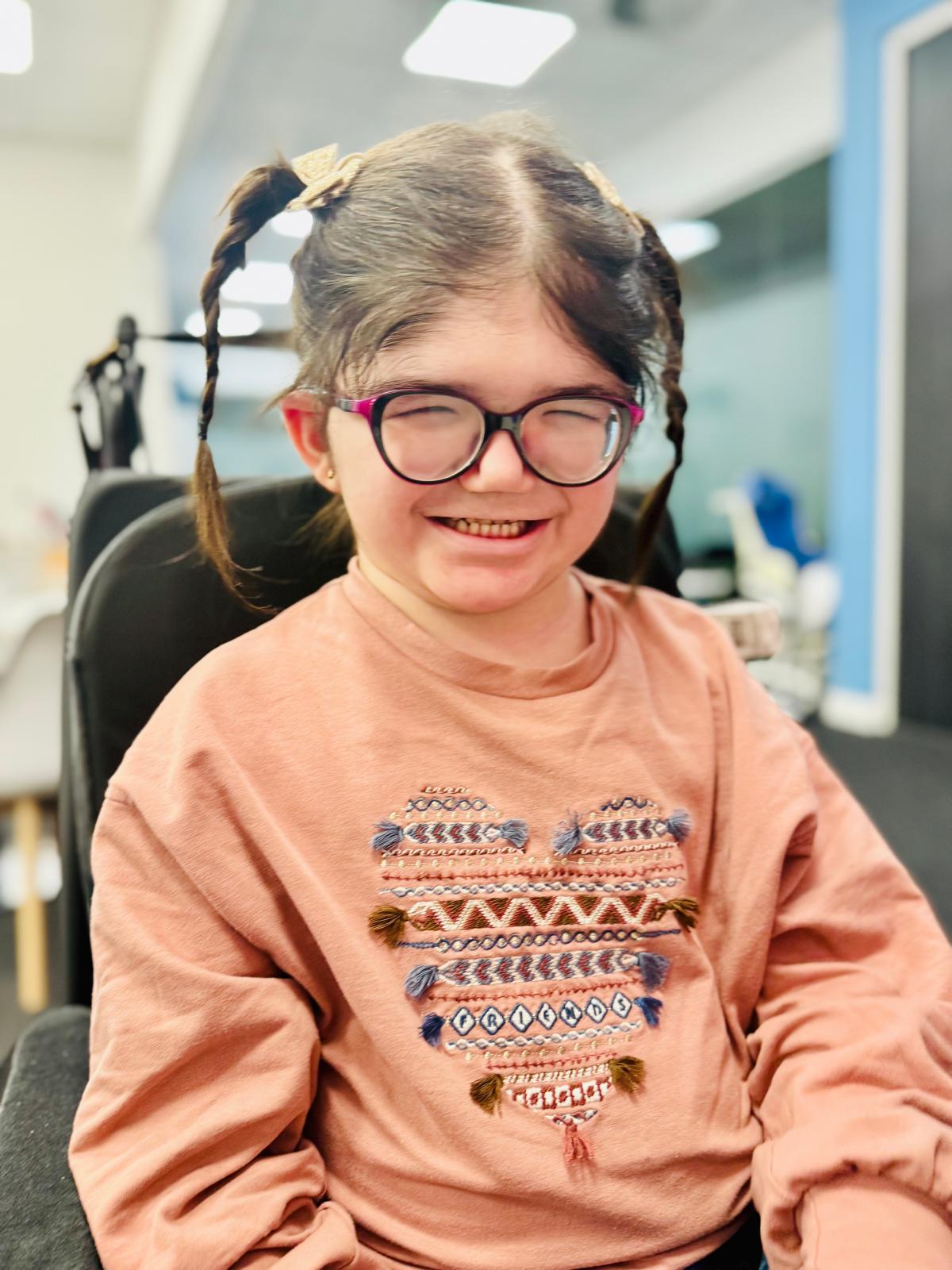
In their October 2026 update, Kate’s parents describe her continuing intensive therapy, standing with less support and developing her use of communication tools. She remains non-verbal, uses a wheelchair, cannot yet walk independently and needs extensive daily assistance.
One recent cinema visit captured what progress means to her family: Kate watched the film while eating popcorn independently and holding her drink. An ordinary childhood moment, made possible by years of effort.
Support continues at home
Kate’s care extends far beyond appointments. Her daily routine involves positioning, movement, communication, respiratory support and personal care. Her family uses wheelchairs, standing frames, gait trainers, orthotic supports, hoists and specialist bathing equipment, alongside communication tools and BiPAP.
An adapted home and therapy equipment help make daily practice and care possible. As Kate grows, equipment needs maintenance, adjustment and replacement. Her family describes both the physical demands of care and the emotional weight of navigating a rare condition.
Why support matters
In their account dated 6 October 2026, Kate’s parents say the therapy and treatment programmes they try to maintain exceed €100,000 each year, before many additional travel and day-to-day care expenses. This describes their ongoing needs; it is not a total raised or a website fundraising target.
- Therapy and rehabilitation in Malta and abroad.
- Communication tools and support.
- Mobility, respiratory and daily-care equipment, including maintenance and replacement.
- Travel and accommodation for specialist care.
- Accessibility adaptations for everyday participation.
Voice for Kate TBRS Malta (VO2497) grew from fundraising for Kate’s therapy. For her family, giving Kate a voice means communication, inclusion, opportunity and as much independence as she can achieve. The hope is for friendships, play, learning, choices and a happy life. No particular medical outcome is promised.